
The e-commerce landscape in India is no longer just about buying online. By 2026, the market is projected to surpass $200 billion, and with this explosion comes a massive logistical challenge. As consumers move from weekly shopping to instant gratification models, the pressure on the warehouse has shifted from simple storage to high-speed fulfilment.
For a warehouse to survive this transition, the four walls aren't enough. It is the storage systems inside those walls that determine whether a business scales or stalls.
At Kompress India, we’ve seen firsthand how the right storage architecture transforms a chaotic godown into a high-performance fulfilment hub. Here is how advanced storage systems are fuelling the growth of modern e-commerce.
1. Reclaiming the Vertical Goldmine
In Tier-1 cities like Mumbai, Delhi, and Bangalore, real estate costs are skyrocketing. E-commerce players cannot afford to simply "buy more land." The solution? Verticality.
Modern storage systems, such as Multi-Tier Racking, allow warehouses to double or triple their usable floor space without changing their footprint. By utilizing the full height of the building, businesses can house a much larger variety of SKUs (Stock Keeping Units), which is essential for the infinite aisle promise of e-commerce.
2. Speed: The Death of the Fixed Aisle
In a traditional warehouse, 50% of a picker's time is spent walking. In e-commerce, where Same Day Delivery is the benchmark, walking is a waste of money.
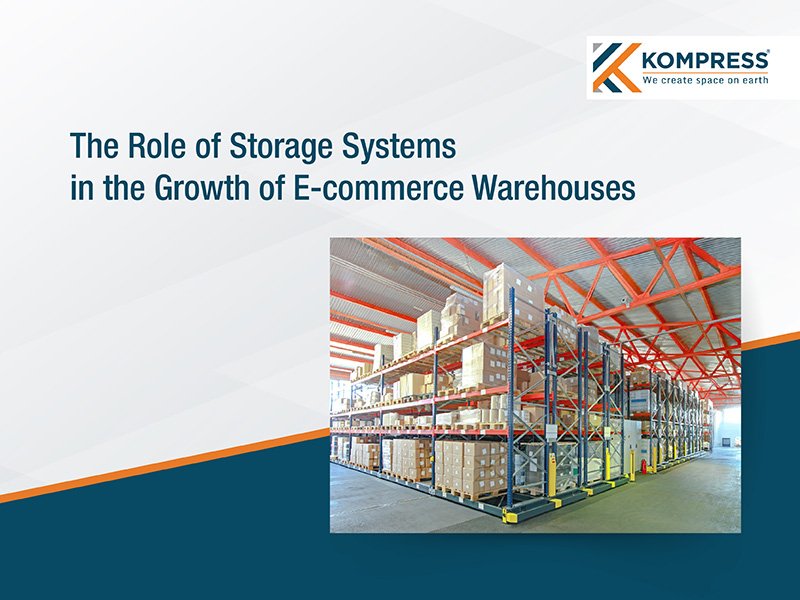
High-Density Mobile Compactor Systems and Motorized Racking eliminate unnecessary aisles. With the touch of a button, these systems create an aisle only where it’s needed.
• The Result: You store more in less space while ensuring that every item remains accessible for rapid picking.
3. The Rise of the Micro-Fulfilment Centre (MFC)
As e-commerce moves closer to the customer, we are seeing a shift toward smaller, urban warehouses. These MFCs don't have the luxury of space.
This is where AS/RS (Automated Storage and Retrieval Systems) and Mini-Load Systems become game-changers. These systems automatically bring the goods to the person, eliminating human error and drastically reducing the click-to-ship cycle time. For Kompress, integrating AS/RS into urban hubs is the key to supporting the next wave of Quick Commerce.
4. Accuracy is the New Customer Service
In e-commerce, a wrong item delivered is a logistical nightmare involving RTO (Return to Origin) costs and a lost customer.
Modern storage isn't just steel and bolts; it’s integrated with WMS (Warehouse Management Systems). Systems like Pallet Shuttle Racking or Pick-to-Light shelving guide workers with surgical precision. When your storage system talks to your software, inventory accuracy nears 99.9%, reducing the overhead of returns and keeping customers happy.
The Kompress Edge: Future-Proofing Your Growth
At Kompress India, we don't just sell racks; we engineer efficiency. Our Concept to Commissioning approach ensures that your storage evolves with your order volume.
• Modular Design: Our systems are built to be scalable. Start small and add capacity as your SKU count grows.
• In-House Precision: From design to execution, everything is handled in-house to ensure the highest safety and quality standards.
• Space Optimization: We help businesses reclaim up to 80% of their lost space, turning overhead costs into operational assets.
Conclusion
The future of e-commerce isn't just in the app, it's in the aisle. As the industry grows, the winners will be those who treat their warehouse storage not as a cost centre, but as a competitive advantage.
Is your warehouse ready for the 2026 e-commerce surge? Contact Kompress India today for a site analysis and discover how we can help you store more, move faster, and grow bigger.

 kompressindia.com