
In pharmaceutical manufacturing, every raw material has a purpose. Some are used daily, while others are needed only for certain batches. But all of them must be stored carefully, identified correctly, and available when production needs them.
Now imagine a production team waiting for a raw material that has already arrived at the factory. The material is somewhere in the warehouse, but locating the correct batch is taking longer than expected. Meanwhile, new shipments are waiting to be stored.
Situations like these show why pharmaceutical storage needs careful planning. It isn't simply about finding enough room for pallets. It's about keeping materials organized and supporting a smooth flow between the warehouse and production floor.
A motorised racking system can help manufacturers manage pallet storage more effectively, especially when space is limited and large volumes of material must be handled.
Why Is Raw Material Storage Important in Pharmaceutical Manufacturing?
Raw material storage plays a direct role in how smoothly a pharmaceutical plant operates. Materials must be received, checked, identified, stored, and released for production according to the company's quality procedures.
Unlike general warehouse stock, pharmaceutical materials may have specific storage conditions, expiry dates, and batch identification requirements.
For example, two containers may hold the same ingredient but belong to different batches. If those batches are mixed up, the error could affect production records and material traceability.
This is why pharmaceutical warehouses need clearly defined storage locations and proper stock identification.
Good warehouse storage solutions can support this process by keeping materials organized and making approved stock easier to locate. However, racking equipment must work alongside quality checks, inventory records, and the plant's storage procedures.
What Is a Motorised Racking System?
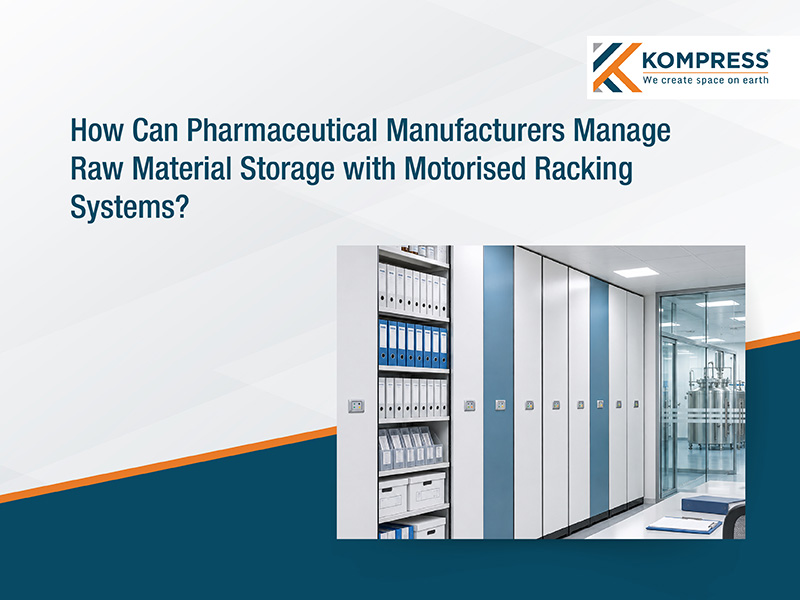
A motorised racking system uses electrically powered mobile storage units that move along guided rails. Instead of keeping a permanent aisle between every row, the units move to create an access aisle where it's needed.
Workers can operate the movement through suitable controls, depending on the system design.
This arrangement allows businesses to reduce the space occupied by fixed aisles while maintaining access to stored materials.
In pharmaceutical warehouses, heavy-duty motorised systems can be designed for palletized raw materials. They may be useful when a facility needs high-density storage but has limited room for additional fixed racks.
The system must be selected according to the weight of stored materials, handling equipment, and required access.
Keep Different Material Batches Clearly Organized
One of the biggest challenges in pharmaceutical storage is keeping track of material batches.
A warehouse may receive the same raw material from different deliveries, each with its own batch number, expiry date, and inspection status.
Without a clear location system, identifying the correct stock becomes difficult.
A practical approach is to assign specific storage locations and link them to inventory records. Each pallet should have the required identification, while warehouse staff should be able to locate the material without confusion.
A motorised racking system can support this arrangement through defined storage positions and organized pallet access.
However, the racking system doesn't replace batch tracking or quality controls. Those still depend on accurate records and the procedures followed by the warehouse team.
Plan Storage Around Quality Checks and Material Status
Not every raw material that arrives at a pharmaceutical factory can be used immediately.
Incoming materials often need inspection, sampling, and approval before they are released for production.
For this reason, warehouses should have suitable arrangements for materials under quarantine, approved materials, and rejected stock.
For example, a newly received shipment shouldn't be placed into general production stock before the required checks are complete.
The storage layout should help employees identify material status and prevent unauthorized use.
Where mobile racking is used, the layout must still support the required separation, access controls, and handling procedures.
The priority is to maintain a clear and reliable storage process, not simply accommodate more pallets.
Make Pallet Movement Easier to Manage
Moving raw materials in a pharmaceutical warehouse involves more than transporting pallets from one location to another.
Warehouse teams must handle the correct materials, avoid container damage, and ensure the right batch reaches production.
A poorly planned storage area can create delays when forklifts have limited room to maneuver or workers need to move several pallets to reach one.
Heavy-duty motorised mobile racks can create access aisles as needed, allowing suitable material-handling equipment to reach designated storage positions.
However, aisle widths, load limits, floor strength, and equipment movement must be considered during system design.
For manufacturers handling frequent material transfers, storage planning should also reflect the number of pallets moved during each shift.
This helps the system support daily production needs rather than becoming a bottleneck.
Support Proper Stock Rotation
Pharmaceutical raw materials often have expiry or retest dates that influence when they should be used.
Many pharmaceutical storage operations follow the First Expiry, First Out (FEFO) principle, which gives priority to suitable materials with earlier expiry dates.
This requires accurate inventory records and clear product identification.
Consider a warehouse receiving a new shipment of an ingredient that expires before an older shipment. The team must be able to identify the correct batch rather than selecting stock based only on arrival date.
Organized warehouse storage solutions can make inventory locations easier to manage, but stock rotation must be controlled through the company's inventory procedures.
Warehouse managers should therefore consider how easily workers can reach specific pallets before finalizing a storage layout.
What Should Manufacturers Check Before Installation?
Before investing in motorised storage equipment, pharmaceutical manufacturers should review the conditions of the warehouse and the needs of their operations.
The first consideration is load capacity. The system must be suitable for the total weight of the pallets, stored materials, and storage structure.
Floor strength is equally important because mobile systems transfer loads through wheels and rails.
Manufacturers should also assess available height, forklift access, power requirements, emergency controls, and maintenance needs.
The installation must allow appropriate cleaning, inspection, and any required environmental monitoring. Materials that need controlled temperature or humidity must remain under suitable conditions.
A site assessment can help identify the right configuration before installation begins.
Frequently Asked Questions
Can motorised racking systems be used for pharmaceutical raw materials?
Yes. Suitable heavy-duty motorised systems can be used to store palletized pharmaceutical raw materials. The design must meet load, access, safety, and applicable storage requirements.
How does motorised racking support pharmaceutical warehouses?
A motorised racking system can help improve storage density and provide organized access to palletized materials. It should be used alongside proper batch tracking, quality controls, and inventory management procedures.
What should pharmaceutical manufacturers consider when choosing warehouse storage solutions?
Manufacturers should evaluate material weight, batch identification, storage conditions, access frequency, floor strength, handling equipment, and applicable quality requirements.
Manufacturers should evaluate material weight, batch identification, storage conditions, access frequency, floor strength, handling equipment, and applicable quality requirements.
In pharmaceutical manufacturing, an organized warehouse helps ensure the right materials are available when they're needed. Clear batch identification, proper stock rotation, and safe handling all contribute to smoother operations.
Choosing the right storage equipment is one part of making that happen.
Kompress India offers heavy-duty motorised mobile storage systems for industrial applications, including palletized raw material storage in pharmaceutical facilities. Its MOTORACK system has also been used in a pharmaceutical manufacturing project for Piramal Pharma.
For manufacturers planning to upgrade their facilities, a carefully designed motorised racking system can be a practical part of a larger storage improvement plan.
Explore Kompress India's motorised mobile storage solutions to find a suitable configuration for your pharmaceutical warehouse.

 kompressindia.com
