
For Kompress India, a pioneer in storage management, staying ahead means integrating space-saving engineering with cutting-edge technology. This blog explores how smart automation is reshaping the Indian storage sector.
1. The Dawn of Smart Warehousing in India
Traditionally, Indian warehouses faced challenges like high land costs, manual errors, and labor-intensive processes. Today, a Smart Warehouse uses an interconnected ecosystem of IoT, AI, and robotics to automate the journey of a product from the loading dock to the shipping area.
2. Key Features of an Automated Warehouse
To transform a facility into a "smart" asset, several core technologies must work in harmony:
• ASRS (Automated Storage and Retrieval Systems): High-density racking systems that use cranes or shuttles to retrieve items, maximizing vertical space.
• Warehouse Management Systems (WMS): The brain of the operation that provides real-time data on inventory levels, locations, and movement.
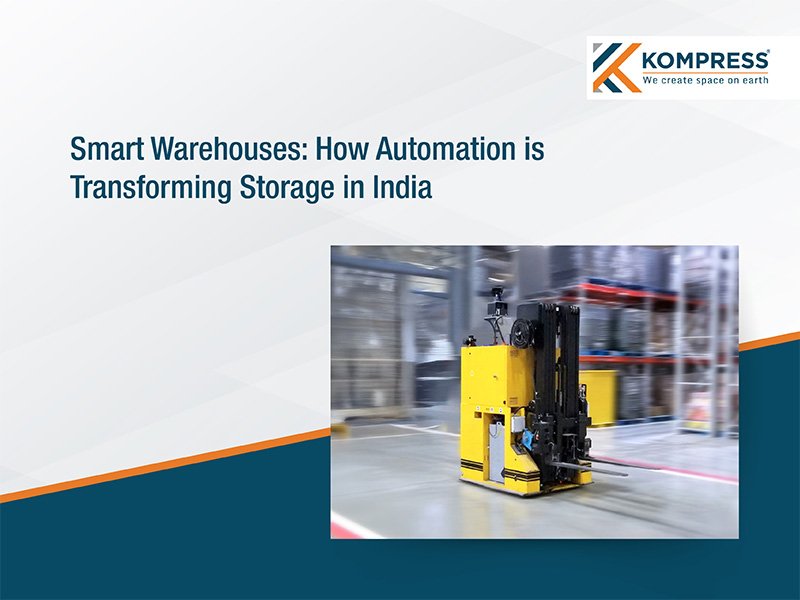
• AGVs & AMRs: Automated Guided Vehicles that transport heavy pallets without human intervention, reducing floor accidents.
• High-Density Motorized Systems: Specialized solutions like those from Kompress that can increase storage capacity by nearly 100% within the same footprint.
3. Benefits: Why Indian Businesses are Switching
The ROI of automation in the Indian context is driven by efficiency and space optimization:
| Benefit | Impact on Operations |
|---|---|
| Space Maximization | Vertical storage and compact racking reduce the need for expensive real estate expansion. |
| Error Reduction | Automated picking and RFID tracking bring inventory accuracy close to 99.9%. |
| Labor Efficiency | Automation handles repetitive, heavy-lifting tasks, allowing staff to focus on quality control. |
| Scalability | Modular systems (like Pallet Shuttles) allow warehouses to scale up as demand grows. |
| Safety | Minimized human-machine interaction in high-risk zones reduces workplace injuries. |
4. Kompress India’s Edge in Automation
Kompress India bridges the gap between traditional storage and future-ready automation. Our solutions are designed for the unique constraints of the Indian market:
• Pallet Shuttle Systems: Remotely controlled shuttles that carry loads into deep-lane racking, ideal for FIFO/LIFO management.
• Mobile Racking: Eliminates multiple aisles, opening only the one needed, which saves up to 50% floor space.
5. Frequently Asked Questions (FAQ)
Q1: Is warehouse automation expensive for small Indian enterprises?
While the initial investment is higher than manual racking, the long-term savings in real estate, reduced damage, and labor costs typically lead to a positive ROI within 3–5 years.
Q2: Can existing warehouses be retrofitted with automation?
Yes. Many Kompress solutions, such as motorized compactors or semi-automated pallet shuttles, can be integrated into existing facilities without a complete overhaul.
Q3: How does automation help in the Cold Chain sector?
Automation reduces the time doors stay open and minimizes human presence in sub-zero temperatures, maintaining a consistent thermal envelope and saving energy.
6. Keywords for SEO
• Warehouse Automation India
• Smart Storage Solutions
• ASRS Systems India
• Kompress India Storage
• Space Optimization Logistics
• Automated Pallet Racking
• Intelligent Warehousing 2026
• Industrial Storage Systems India
Looking to Future-Proof Your Storage?
At Kompress India, we don't just provide racks; we provide solutions that grow with you. Contact us today to learn how our automated systems can turn your warehouse into a high-performing asset.

 kompressindia.com